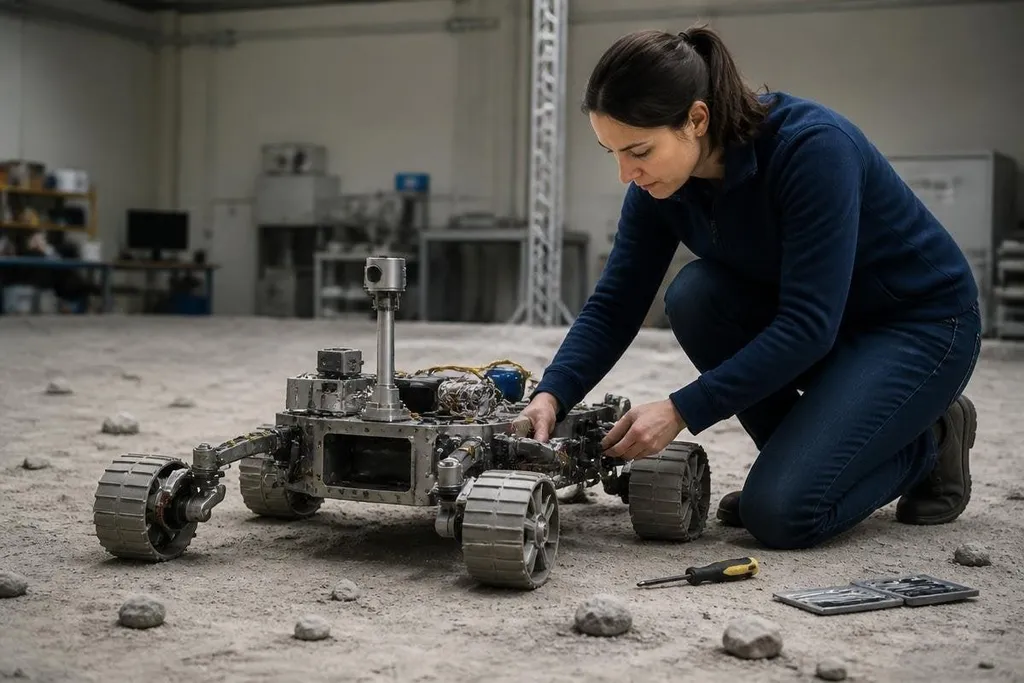
A space robot can lose its mission over one damaged wheel, weak seal, or failed sensor. New space robots will need to handle dust, radiation, vacuum, and low gravity. They may also face long gaps in communication without a repair shop nearby.
- Remote help has limits: Radio commands can’t replace local decisions when signals take time to travel.
- The body matters: Seals, joints, wheels, and power systems must keep working through dust and temperature changes.
- The real test: A useful robot needs to recover from faults, not only complete a clean demonstration.
Autonomy starts with fault handling
A robot on another world can’t wait for a person to guide every movement. Its software needs to spot a slipping wheel, blocked arm, low battery, or sensor error and choose a safe response.
That response might mean stopping the arm, changing the route, switching to another sensor, or returning to a known position. The robot also needs to record what happened so a control team can diagnose the fault later.
This is a different job from following a fixed command list. A fixed list works when the ground, lighting, and hardware match the plan. Space rarely offers that match twice.
Hardware has to survive the surface
Dust can enter joints, cover cameras, reduce grip, and affect seals. A robot built for a dusty surface needs protection around moving parts, a way to clean or shake off dust, and sensors that still work when their view is partly blocked.
Vacuum removes air that would carry heat away from the robot. Engineers must move heat through the frame, radiators, or other paths instead. That makes the placement of batteries, motors, computers, and electronics part of the robot’s survival plan.
Radiation can also damage electronics over time. A space robot may need shielded parts, spare computing paths, and software that checks memory for errors. The exact design depends on the destination and the planned mission length, so a single “space-ready” label says very little on its own.
Movement needs more than a map
Low gravity changes how a robot pushes against the ground. A wheel can spin without moving the body forward, while an arm can push the robot off balance during a simple reach.
That makes contact sensing important. The robot needs to know when a wheel has firm ground, when a foot has slipped, or when an arm has met more resistance than expected. Cameras and LiDAR can help build a map, but the robot still needs control software that reacts to contact.
The same rule applies to flying robots. A drone or small hopper needs a clear power budget, a known landing plan, and a way to recover when the surface differs from its map. A clean route on paper won’t cover every rock or slope.
A space robot’s power budget decides which sensors run, how far it travels, and when it must stop. Reporting from Robot24 can put the named mission, machine, and date beside that power claim before the next section sets the work plan.
Power sets the work plan
Its power supply is limited, and work may stop when sunlight, temperature, or battery charge falls outside the planned range. Every movement has a cost, from waking a camera to driving a wheel or heating an actuator.
Designers therefore need to rank tasks before launch. A robot might spend power on a sample tool, communication link, or safe return rather than finish a lower-value inspection. The software should make that choice from clear rules that people can review.
I’d judge a space robot by its recovery plan before its smoothest demonstration. A machine that moves slowly but keeps working after a sensor fault may be more useful than one that moves quickly in a controlled test.
Check these points before backing a design
Use this list when reviewing a proposed space robot, mission plan, or supplier claim:
- Fault response: What does the robot do after a wheel, arm, camera, or computer error?
- Dust control: Which joints and sensors are protected, and how can the robot clear dust?
- Thermal path: Where does heat leave the motors, battery, and computer in vacuum?
- Power reserve: How much energy remains for a safe return or recovery task?
- Communication delay: Which actions happen locally when a control team can’t respond at once?
- Service plan: Can the robot swap a tool, use a spare path, or diagnose a failed part?
New space robots will earn trust through fault logs, recovery tests, and hardware that survives the surface. Until those results are public, the useful question is simple: what can the robot still do after its first failure?